
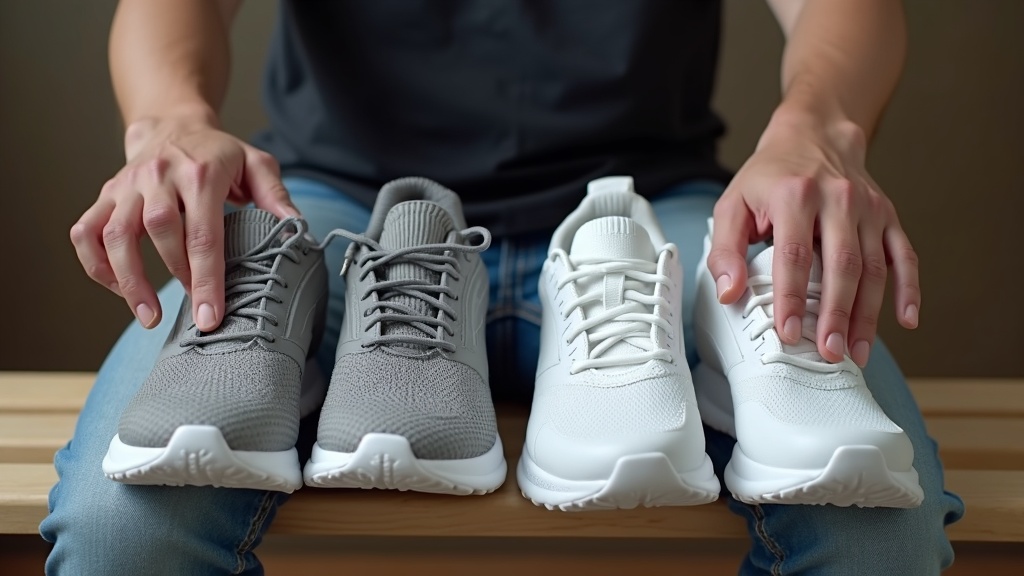
Buying walking or running shoes that actually fit means measuring both feet late in the day, leaving a thumb’s width of space at the longest toe, and walking around the store for several minutes before deciding — not just grabbing your usual size off the shelf. Fit varies significantly between brands and even between models from the same brand, so the number printed inside an old pair is only a starting point. The real test happens with socks on, on your feet, moving.
Why “your size” isn’t reliable
Shoe sizing is not standardized the way, say, a gallon of milk is. A size 9 in one brand’s running shoe can measure differently in length and width than a size 9 in another brand, or even in a different model from the same company. Lasts — the foot-shaped molds shoes are built around — change from season to season and from category to category. A cushioned trail shoe and a lightweight road-running shoe from the same label may fit like two different sizes entirely.
This is why relying on memory or a size chart alone tends to backfire. It’s also why trying shoes on in person, or at minimum ordering from a retailer with an easy return policy, matters more for footwear than almost any other household purchase. If you’re shopping online, it helps to think through how return policies should factor into buying before you click “add to cart,” since you may need to send a pair back once you actually walk in them.
Measure your feet properly — both of them
Most people have one foot slightly larger than the other, and most people’s feet are also slightly longer and wider at the end of the day than first thing in the morning, due to normal fluid movement. For that reason:
- Measure feet in the afternoon or evening, not right after waking up.
- Measure both feet and buy for the larger one.
- Measure while standing, since feet flatten and lengthen slightly under body weight.
- Measure length and width — a shoe that’s the right length but too narrow or too wide will cause blisters or instability no matter how good the cushioning is.
Many stores that specialize in athletic footwear offer a simple foot-measuring device (a Brannock device) at no charge. It’s worth using even if you’re confident about your size, because feet do change over years, especially after pregnancy, significant weight change, or simply aging — connective tissue loosens and feet can lengthen or widen over time.
Fit the shoe to the activity
Walking shoes and running shoes are built differently, and buying one when you actually need the other is a common mistake. Running shoes generally have more cushioning and flexibility built for a rolling foot strike at speed. Walking shoes tend to have a lower profile, a different heel-to-toe drop, and a sturdier sole meant for a steadier, flatter gait. If you do both activities regularly, look at which one you do more, and prioritize that.
Key things to check on the shoe itself
- Toe box room: your longest toe (which isn’t always the big toe) should have roughly a thumb’s width of space before the end of the shoe.
- Width: the shoe shouldn’t pinch across the ball of the foot or leave the foot sliding side to side. Many brands offer narrow, standard, and wide versions of the same model — worth asking about if the standard width never quite feels right.
- Heel hold: your heel shouldn’t lift more than a small amount when you walk or jog in place. Excessive heel slip usually means the shoe is too big or the wrong shape for your foot, not that you need thicker socks.
- Arch and midfoot support: the shoe should feel supportive under the arch without pressing into it uncomfortably. If you have flat feet or high arches, this matters more than most other factors.
- Flex point: the shoe should bend where your foot naturally bends (at the ball of the foot), not in the middle of the arch.
Try them on the way you’ll actually use them
Wear the socks you’ll actually exercise in when trying shoes on — thick athletic socks fit differently than thin dress socks. If you use orthotic inserts, bring them along and try shoes with the insert in place, since it changes the internal volume of the shoe.
Don’t just stand at the mirror. Walk the length of the store. If jogging in place is allowed, do that too. Go up on your toes to check heel slip, and walk on any incline or step available. Shoes that feel fine standing still can reveal pressure points, rubbing, or heel lift only once you’re moving the way you actually will outside the store.
Shop later in the day when possible, and don’t be talked into “it’ll stretch” or “it’ll break in” if a shoe feels tight or uncomfortable in the store. Uppers can loosen slightly with wear, but a shoe that’s genuinely too small or the wrong shape rarely becomes comfortable — it just causes damage more slowly.
Weighing store brand versus name brand
Athletic footwear is one category where the gap between store brand and name brand can be more noticeable than in, say, pantry staples, mostly because of differences in cushioning technology, outsole durability, and available width options. That doesn’t mean a store brand is automatically worse — some private-label athletic shoes use comparable materials at a lower cost, they just may offer fewer width or support variations. It’s worth reading through the general reasoning in store brand vs name brand: when it matters before assuming one category is always the better buy.
Timing the purchase
Athletic shoes don’t follow quite the same clearance calendar as heavier seasonal goods, but retailers do commonly discount past-season colorways and models once a newer version launches, which typically happens on a yearly or twice-yearly cycle depending on the brand. Outdoor and cold-weather footwear also tends to get marked down alongside general seasonal apparel clearance — a pattern covered in more detail in the piece on when winter coats and boots go on clearance, since some of the same seasonal clearance logic applies to athletic and casual footwear sold alongside it.
If you’re trying to find a fair price once you know the model and size that actually fits, comparing listings across a few retailers is worth the extra few minutes — see how to comparison shop without wasting hours for a way to do that efficiently instead of opening a dozen browser tabs. Some shoppers also use browser-based tools to track price history on a specific model once they’ve confirmed fit in person; the general mechanics are explained in how price-tracking tools actually work.
If you belong to a retailer’s loyalty program already, it may be worth checking whether it offers early access to sales or member-only markdowns on footwear before you buy elsewhere — the tradeoffs of joining are covered in are store loyalty programs worth signing up for.
Signs a “fitting” shoe is actually wrong
| Symptom | Likely cause |
|---|---|
| Black or bruised toenail after wear | Shoe too short, or laced too loosely allowing the foot to slide forward |
| Blisters on the sides of the foot | Shoe too narrow for foot width |
| Heel rubbing or blistering | Poor heel hold, often from a shoe that’s too big overall |
| Numbness across the top of the foot | Laced too tightly, or insufficient volume in the upper |
| Arch pain after short walks | Insufficient or mismatched arch support for your foot type |
Frequently asked questions about buying walking or running shoes that fit
How much space should be at the end of my shoe?
Aim for roughly a thumb’s width — about half an inch — between your longest toe and the end of the shoe. Less than that and toes get jammed on downhills or long walks; much more and your foot slides forward, causing blisters and toenail bruising over time.
Should I buy running shoes a half size bigger?
Many people do, since feet swell slightly during exercise and on longer walks or runs, and a snug toe box can cause bruised toenails on downhill stretches. It depends on the shoe’s shape, though, so try the true size first and size up only if your longest toe feels cramped.
How often should I replace walking or running shoes?
A common general guideline is every 300-500 miles of use, or sooner if the tread is visibly worn or the midsole feels noticeably flatter than when new, since cushioning breaks down even if the outer fabric still looks fine.
Do I need different shoes for walking versus running?
Ideally yes, since running shoes are built for a rolling foot strike and impact at speed while walking shoes are built for a steadier, flatter gait. If you mostly do one activity, prioritize a shoe designed for that; a hybrid shoe is a reasonable compromise if you do both fairly evenly.
Why do my feet feel different sizes between brands?
Shoe sizing isn’t standardized across brands, and even models within the same brand use different lasts, or foot-shaped molds. That’s why measuring your feet, trying shoes on with the socks and inserts you’ll actually use, and walking around the store matter more than trusting a printed size number.
Shopper Marts publishes general shopping and buying information, not financial advice, and we are not a retailer. We do not verify real-time prices, stock, or sale terms — always confirm current price, availability, and return policy directly with the seller before buying. Product categories, not specific real brands or models, are discussed unless otherwise noted, and nothing here is a guarantee of price or performance.