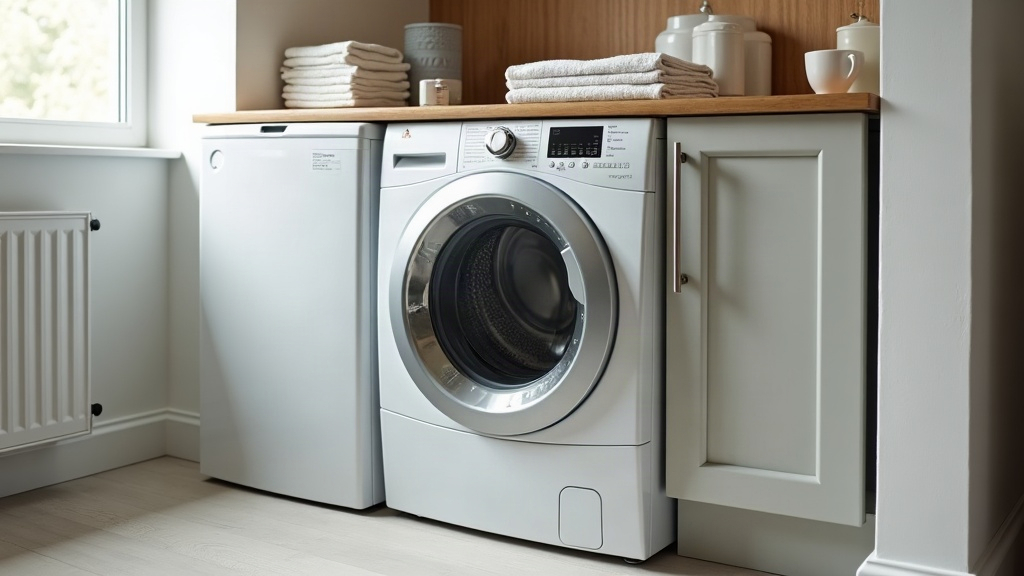
Before buying a space-saving washer/dryer combo, check four things in this order: whether it physically fits your doorway, closet, and hookups; whether it’s a true all-in-one unit or a stackable vented/ventless pair; how its cycle time stacks up against your actual weekly laundry volume; and what happens for service and parts once it’s out of warranty. The cycle-time piece is the one most buying guides skip, and it’s often the one that determines whether you’ll be happy with the thing six months in.
Start with the math nobody puts on the spec sheet
Here’s the trade-off that gets glossed over in most comparisons: a true all-in-one combo — one drum that washes and then dries the same load without you touching it — is almost always ventless, and ventless drying is slower than vented drying because it relies on condensation or a heat-pump cycle instead of blowing moist air outside. A full wash-and-dry cycle on these units commonly runs 2.5 to 4 hours per load, depending on fabric type, load size, and how much drying the cycle is set to do. A stacked pair — separate washer and dryer, one mounted above the other — lets you run a wash cycle in roughly 30 to 60 minutes and then move the load to the dryer, which runs independently while you start the next wash. Because the two drums work in parallel instead of one drum doing both jobs in sequence, your hands-on turnaround for stacked pairs often lands close to an hour per load, even though total appliance runtime across both machines is higher.
That difference compounds fast once you look at it across a week instead of a single load:
| Loads per week | All-in-one combo (3 hrs/load tied up) | Stacked pair (1 hr wash, dryer runs in parallel) |
|---|---|---|
| 2 | 6 hours | 2 hours |
| 3 | 9 hours | 3 hours |
| 5 | 15 hours | 5 hours |
| 7 | 21 hours | 7 hours |
The decision rule that falls out of that table: if your household does more than roughly three loads of laundry a week, the time cost of a single-drum combo usually outweighs the square footage it saves you. Below that threshold — a studio apartment, a single person, a couple without kids — the combo’s smaller footprint is a reasonable trade for the longer cycle, because you’re only tying up the one drum a couple of times a week and can plan around it. Above it, you’re looking at the equivalent of a part-time appliance commitment: no second load until the first one finishes completely, no quick re-wash of a stinky gym bag, no running a load overnight and switching it to the dryer in the morning because the whole cycle already happened unattended. For larger households, a stacked vented or ventless pair in the same footprint as many combos will get the laundry done in a fraction of the total time, even if the unit itself is a few inches taller.
Measure the space before you measure anything else
Dimensions matter more for combos and stacked units than for standard side-by-side pairs because there’s so little margin for error. Before shopping, check:
- Doorway and hallway clearance — not just the width of the final spot, but every turn the unit has to make getting there, including whether it comes in one piece or needs the top removed for delivery.
- Closet or nook height for stacked units, including the stacking kit’s added height, which is usually sold separately and isn’t always included in the listed unit dimensions.
- Hookup type — a standard 120V outlet versus a dedicated 240V line for electric dryers, and whether a water supply and drain are already present or need to be added.
- Venting availability — if there’s no existing dryer vent and adding one isn’t realistic, that alone may decide between a vented stackable pair and a ventless combo or ventless stackable pair.
If you’re not sure which category of appliance even makes sense for your space before you get this granular, the home appliances buying guides archive is a reasonable starting point for comparing formats side by side at /category/home-appliances-buying-guides/, and the broader /buying-guides/ hub covers appliance shopping alongside other big household purchases.
Vented, ventless, and “true combo” are three different things
It’s easy to use these terms loosely, but they describe meaningfully different machines:
- Stacked vented pair — two separate machines, the dryer vents moist air outside through ductwork. Fastest drying, but requires an existing or installable vent.
- Stacked ventless pair — two separate machines, but the dryer uses a condenser or heat pump instead of a vent. No ductwork needed, drying is somewhat slower than vented but still runs as an independent drum.
- All-in-one combo — one drum, one door, washes and dries the same load automatically. Almost always ventless, and this is the category where the 2.5–4 hour cycle time applies.
Ventless drying in general tends to leave clothes slightly less perfectly dry at the end of a standard cycle, and manufacturers vary in how well they manage condensation or water reservoirs that need emptying — a detail worth confirming in the manual before you buy, not after.
Capacity shrinks along with the footprint
Combo and compact stackable units are usually rated in smaller capacities than full-size side-by-side machines, often in the range used for one to two people per load rather than a family-size wash. That means more loads to get through the same amount of laundry, which pushes you further up the table above — a household that would do three loads a week on a full-size washer might need four or five smaller loads on a compact unit, nudging it right past the threshold where a stacked pair starts to make more sense. Check the manufacturer’s capacity rating against the size of a typical load for your household — a stack of towels and a comforter can fill a compact drum fast.
Noise, vibration, and where it’s actually going
Compact and all-in-one units are often installed in closets, kitchens, or bathrooms close to living space, so vibration and noise matter more than they would in a basement or garage laundry room. A unit sitting on hard flooring without proper leveling feet or anti-vibration pads can transmit noise through walls in ways that a full-size laundry room setup wouldn’t. If the install surface isn’t perfectly level, higher spin speeds — which you want for shorter dry times — can make the unit walk or vibrate noticeably.
Energy and water use work differently in this category
Ventless drying cycles generally use more energy per load than vented drying because the unit has to manage moisture internally rather than exhausting it, and condenser-style units can also use somewhat more water in the drying phase. Checking a unit’s ENERGY STAR certification is a reasonable way to compare relative efficiency across models in the same category, since certified clothes washers and dryers are tested against a common federal standard rather than marketing claims (ENERGY STAR). The U.S. Department of Energy’s consumer guidance on clothes dryers is also useful background on how ventless and heat-pump drying actually compare to vented systems on efficiency and run time (Energy Saver, Department of Energy).
Warranty, service, and parts availability
A single-drum combo has more moving parts doing more jobs in the same housing, which generally means more that can go wrong in one place rather than spread across two separate machines. Before buying, find out whether warranty service is handled by the manufacturer directly or through a local appliance repair network, how long parts are typically stocked for that model line, and whether a failure means the whole unit goes out for repair or just the washer or dryer side. If you’re weighing a used or open-box combo to save further on space and cost, the same due-diligence steps that apply to any secondhand major appliance still apply here, including checking for recall history and asking about prior repairs, which is covered in more detail at /used-refurbished-appliance-checklist/.
Dryer lint and moisture buildup are also a fire-safety consideration worth checking regardless of format — ventless units in particular need their condenser filters and reservoirs cleaned on a schedule the manual specifies, since skipping it affects both drying performance and safety. The Consumer Product Safety Commission has general guidance on dryer maintenance and fire prevention that applies across vented and ventless designs alike (U.S. Consumer Product Safety Commission).
Comparing price across formats
Because combos, compact stackable pairs, and full-size units aren’t directly comparable on sticker price alone, it helps to price out the full setup — including a stacking kit, any venting work, and delivery — before comparing against a stacked pair’s combined cost. A mid-range compact unit might run somewhere in a noticeably different band than a comparable full-size pair, but check current listings rather than relying on a number that will be stale by the time you read this. The smart shopping guide hub has general approaches for comparing prices across different configurations of the same category at /smart-shopping-guide/, and if a retailer’s price seems inconsistent with what you’re seeing elsewhere, it’s worth understanding how price-matching policies actually work before assuming you’re getting the better deal at /how-price-matching-policies-work/.
Finally, don’t forget that whatever you buy still has to interact with your actual linens and towels — a combo with a long, low-heat ventless cycle can be gentler on fabric over time, which is worth factoring in alongside how you choose bedding that holds up to repeated washing in the first place, covered at /bedding-that-holds-up-to-washing/.
Shopper Marts publishes general shopping and buying information, not financial advice, and we are not a retailer. We do not verify real-time prices, stock, or sale terms — always confirm current price, availability, and return policy directly with the seller before buying. Product categories, not specific real brands or models, are discussed unless otherwise noted, and nothing here is a guarantee of price or performance.